
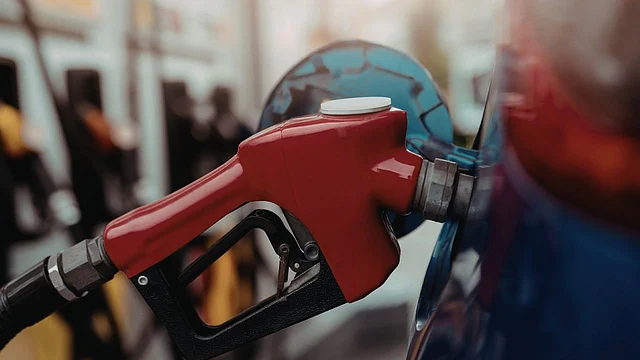
E85 Flex-Fuel Introduced in Delhi at ₹82.12/Litre: Is the ₹20 Discount Worth It?
In a major step toward promoting sustainable mobility, Union Minister for Petroleum and Natural Gas Hardeep Singh Puri inaugurated Delhi’s very first E85 fuel dispensing station at Pusa Road on June 5, 2026. Set up by Indian Oil, this launch officially marks the entry of high-blend ethanol fuel into the capital’s retail market, with dedicated branding to distinguish it from standard pumps.
Add rightsofemployees.com as a Preferred Source




While the retail price looks highly attractive on paper, a deeper look at ethanol’s energy density reveals a complex math equation for potential buyers.
Price Comparison: E85 vs. Existing Fuel Variants in Delhi
The primary hook for E85 is its immediate relief at the billing counter. Here is how the new fuel stacks up against existing options under ₹3 crore per litre:
| Fuel Type | Price per Litre (Delhi) | Price Difference vs. E85 |
| New E85 Flex-Fuel | ₹82.12 | Baseline |
| Regular E20 Petrol | ₹102.12 | ₹20.00 More Expensive |
| Premium XP95 Petrol | ₹109.24 | ₹27.12 More Expensive |
The Efficiency Catch: Analyzing the Value Proposition
While a flat ₹20 discount per litre sounds massive, automotive experts point out that the financial benefit may be entirely offset by a drop in mileage.
-
The Energy Density Deficit: Ethanol contains less energy by volume compared to pure petrol. Consequently, an E85-compliant vehicle is expected to see a 25% to 35% drop in fuel efficiency compared to an identical vehicle running on standard E20 petrol.
-
The Global Benchmark vs. India: In Brazil—the global gold standard for flex-fuel adoption—the price gap between pure ethanol (E100) and their base blend (E27) is maintained at roughly 36% to make up for the mileage drop. In India, the current price gap sits at just 20%, meaning consumers might actually spend a similar amount per kilometer.
-
Higher Upfront Vehicle Costs: Upgrading a vehicle to handle the corrosive properties of high-ethanol blends requires specialized fuel lines and engine calibration. For example, the newly launched E85-compliant Hero Splendor+ carries a ₹6,000 premium over its standard counterpart.
Rollout Roadmap and Network Expansion
The Pusa Road station is just the starting point of a aggressive infrastructure blueprint aimed at supporting early adopters.
-
Short-Term Corridor (Mid-2026): The government plans to deploy 50 to 100 stations focusing on high-density transit paths, specifically the Delhi-NCR and Mumbai-Pune-Nagpur corridors.
-
End of 2026 Target: The network is projected to scale rapidly to 500 operational stations nationwide by December.
-
Long-Term Vision (End of 2027): An ambitious target of 5,000 operational E85 dispensing stations across major Indian metros.
Current and Upcoming E85 Vehicle Lineup
As the refueling network expands, automotive manufacturers are gradually rolling out compatible models:
-
Maruti Suzuki Wagon R Flex-Fuel: The first flex-fuel car to enter mass production in India, though it is currently restricted exclusively to the commercial sector.
-
Hero MotoCorp (Splendor+ & HF Deluxe): Scheduled to become available to private retail buyers starting July 2026.
-
Tata Motors: Has confirmed that their first production-ready flex-fuel vehicle will debut by the end of this year.
-
Toyota: Has repeatedly showcased advanced flex-fuel prototypes of the Innova Hycross, hinting at a premium market launch in the near future.


Recent Posts
- Horoscope Tomorrow, June 6, 2026: Daily Astrology Predictions for All Zodiac Signs
- FD Interest Rates Up to 8.05%: 4 Banks Revise Rates in June 2026
- Online Duplicate Driving Licence Apply Guide 2026
- Polymer Currency: Big statement by RBI, Governor Sanjay Malhotra in preparation to bring plastic notes in India
- NEET UG Re-Exam Admit Card 2026: NTA will release NEET-UG Re-Exam admit card on June 14, know how to download the admit card.
Add rightsofemployees.com as a Preferred Source