
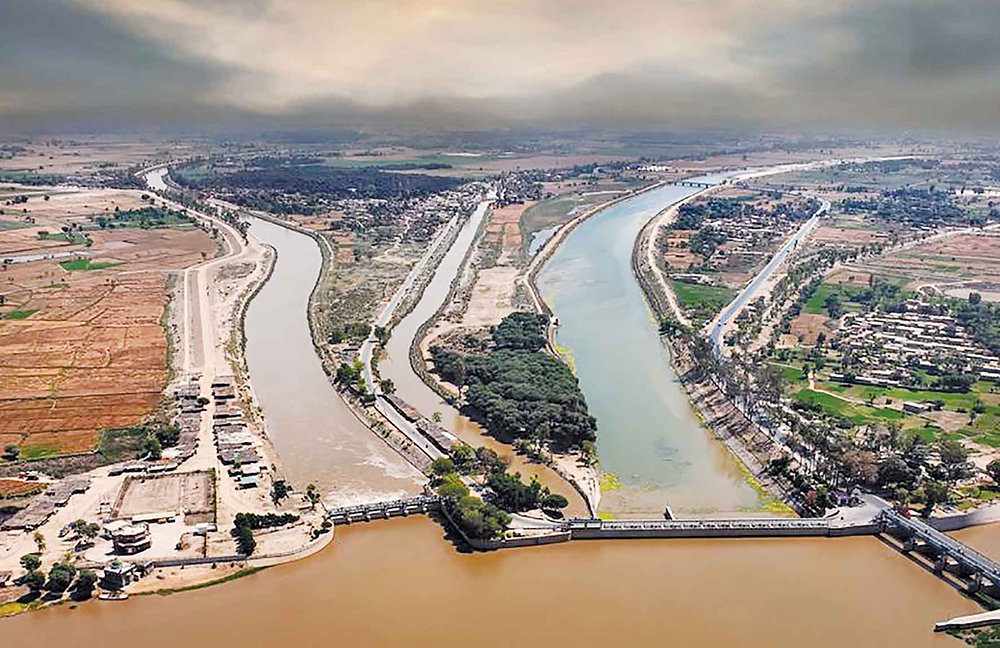
Pakistan Claims Indian Chenab-to-Beas Water Diversion Project Violates Indus Waters Treaty
Tensions surrounding transboundary water distribution have escalated after Pakistan claimed that India’s proposed river-linking project to divert water from the Chenab River constitutes a “grave violation” of the historic 1960 Indus Waters Treaty (IWT) and broader international laws.
Add rightsofemployees.com as a Preferred Source




The statement, delivered by Pakistan Foreign Office spokesperson Tahir Andrabi, comes in response to recent public tender documents revealing India’s intentions to construct the Chenab-Beas Link Tunnel project.
The Core Dispute: The Chenab-Beas Link Tunnel Project
According to the public bidding documents issued by the Government of India, the proposed project aims to construct a massive inter-basin tunnel system.
-
Diverted Volume: The project is designed to transfer 1.9 million acre-feet (MAF) of water annually from the Chenab River basin directly into the Beas River system.
-
Pakistan’s Legal Objections: The Foreign Office spokesperson asserted that this inter-basin transfer breaches multiple international legal frameworks, explicitly citing:
-
The Indus Waters Treaty (IWT) of 1960.
-
The Vienna Convention on the Law of Treaties.
-
The broader framework of international water law, specifically the principles outlined in the 1997 UN Convention on the Law of the Non-Navigational Uses of International Watercourses (referenced contextually as the 1977 framework).
-
Geopolitical Context & The Status of the IWT
The diplomatic friction is intensified by the current fragile state of bilateral water agreements. India placed the 1960 vintage Indus Waters Treaty in “abeyance” last year as part of a series of punitive measures following the April 22 Pahalgam terror attack, which resulted in the casualties of 26 people.
Historically, the World Bank-brokered treaty split the Indus basin’s six rivers between the two nations:
-
Pakistan: Secured rights over the entire flows of the three western rivers: Chenab, Jhelum, and Indus.
-
India: Retained complete rights over the three eastern rivers: Sutlej, Beas, and Ravi.
Because the Chenab is classified as a western river, Pakistan views any unilateral upstream diversion into an eastern river like the Beas as a direct infringement on its allocated water security.
Additional Friction Over Salal Dam Operations
The water dispute extends beyond the proposed tunnel system to active operations at the 690 MW Salal Power Station, a major run-of-the-river hydroelectric project located on the Chenab River in the Reasi district of Jammu and Kashmir.
1. Silt Flushing Row
Pakistan’s Foreign Office claimed that India’s current operational plans regarding the silt flushing of the Salal Dam are prohibited under both the core terms of the IWT and the specific 1978 Salal Agreement.
2. Conflicting Claims on Communication & Flood Alerts
The Foreign Office spokesperson alleged that India has completely bypassed bilateral diplomacy, failing to officially communicate project details, share notices, or seek mutual consultations.
However, domestic operational records within Pakistan present a conflicting timeline regarding communication:
Official Flood Warning Dispatched: On May 22, Pakistan’s Provincial Disaster Management Authority (PDMA) in Punjab province actively put regional departments on high alert following a flood warning.
According to PDMA spokesperson Mazhar Hussain, the high-alert directive originated from data passed by Indian authorities to Pakistan’s Agriculture Department, warning of an increased water inflow and the opening of the spillway gates at the Salal Dam between May 21 and May 30.

Recent Posts
- Horoscope Tomorrow, June 6, 2026: Daily Astrology Predictions for All Zodiac Signs
- FD Interest Rates Up to 8.05%: 4 Banks Revise Rates in June 2026
- Online Duplicate Driving Licence Apply Guide 2026
- Polymer Currency: Big statement by RBI, Governor Sanjay Malhotra in preparation to bring plastic notes in India
- NEET UG Re-Exam Admit Card 2026: NTA will release NEET-UG Re-Exam admit card on June 14, know how to download the admit card.
Add rightsofemployees.com as a Preferred Source