

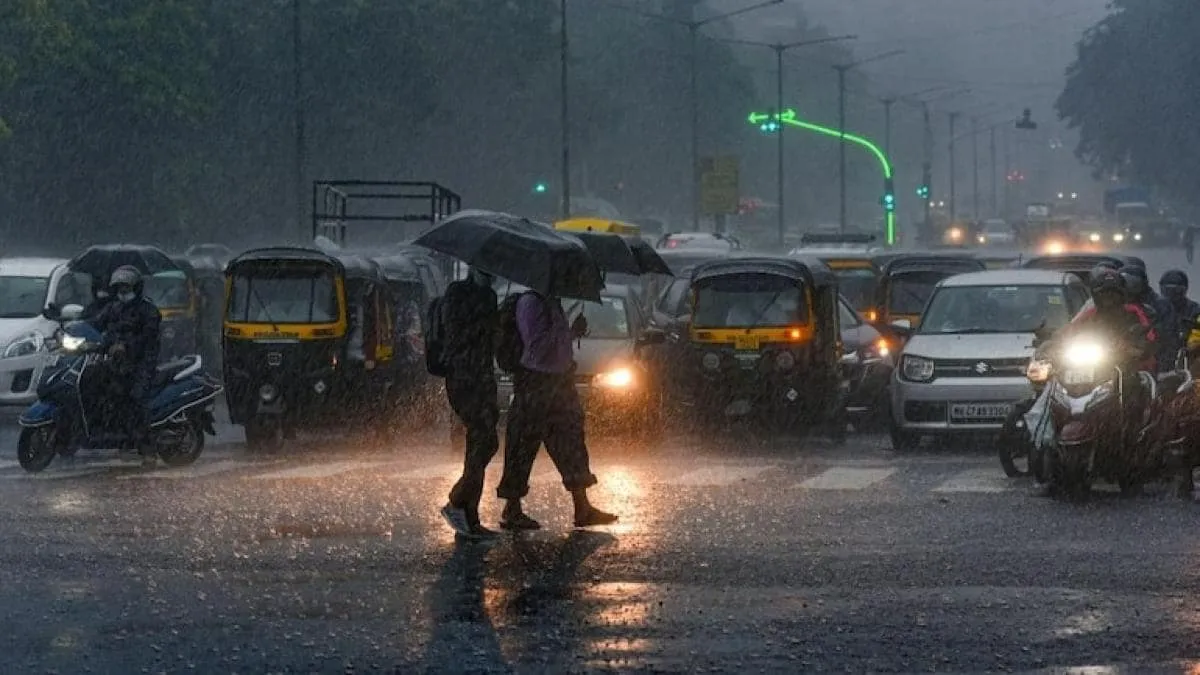
Driven by atmospheric instability over Northwest India, the intense, fast-moving storm system is expected to slash local temperatures while threatening extensive waterlogging across the National Capital Region.
The Indian Meteorological Department (IMD) has issued an emergency Orange alert for the National Capital Region (NCR), predicting a sudden surge of moderate to heavy rainfall accompanied by severe, destructive wind gusts. Regional forecasting stations indicate that parts of New Delhi, Noida, Ghaziabad, Gurugram, and Faridabad are tracking a rapid convergence of thunderclouds, signaling an abrupt end to the oppressive pre-monsoon heat dome.
Add rightsofemployees.com as a Preferred Source


According to live satellite modeling, the incoming rain-bearing system will operate on a staggered timeline across different sectors. Individual neighborhoods are expected to experience intense convective downpours lasting between 30 and 45 minutes, packing high-velocity surface winds ranging from 50 to 80 kilometers per hour.
                        [Delhi-NCR Convective Storm Dynamics]
                                          │
         ┌────────────────────────────────┼────────────────────────────────┐
         ▼                                ▼                                ▼
 [Atmospheric Driver]            [Velocity Matrix]                [Urban Vulnerabilities]
 • Severe pressure instability   • Base gusts: 50 kmph            • Flash waterlogging risks
 • Influx of moisture-laden wind  • Peak wind vectors: 80 kmph     • Peak hour traffic gridlocks
 • Rapid thundercloud expansion  • Short-duration high-intensity  • Temporary structural hazards
Thermal Relief Marred by High-Speed Wind Hazards
“The weather activity is being driven by localized moisture-laden winds interacting with intense atmospheric instability over northwestern India,” stated an IMD regional specialist. “As highly heated surface air collides with cooler incoming maritime moisture, massive towering cumulonimbus clouds are developing rapidly over the NCR. This is setting the stage for sharp thunderstorms, localized dust storms, and immediate thermal drops.”
While the shifting front will bring a welcome plunge in ambient humidity and temperature baselines, the sheer speed of the trailing winds poses localized structural hazards. Disaster management authorities have strongly advised residents to remain indoors during peak convective windows, warning pedestrians and motorists to strictly avoid taking shelter underneath mature trees, old boundary walls, or unanchored metal signboards.
[Intense Heat Baseline Era] ──► Collides with Incoming Maritime Moisture
                                             │
                                             ▼
[Rapid Cumulative Formations] ──► Triggers Sudden 30-45 Minute Heavy Downpour Cells
Traffic Advisories Issued for Crucial Expat and Corporate Commutes
Because the heaviest rainfall cells are modeled to hit during peak evening return windows, municipal authorities are anticipating severe disruptions across the region’s main transit arteries.
Traffic management units have drawn up explicit warning maps for key commuter corridors:
                    [NCR Evening Transit Vulnerability Zones]
                                       │
    ┌──────────────────────────────────┼──────────────────────────────────┐
    ▼                                  ▼                                  ▼
[The Capital Core]             [Cyber City Vector]             [Sattelite Transit Stretches]
• Low-lying waterlogging zones • DND Flyway cross-winds        • Noida-Link Expressway slowdowns
• Ring Road drainage capacity  • NH-48 Gurugram choke points   • Ghaziabad border bottlenecks
• Initial dust visibility drops• Wet asphalt braking hazards   • Commute travel times doubled
Traffic police have advised corporate office-goers heading toward satellite cities to buffer their travel timelines significantly and brace for major delays on the NH-48 highway connecting Delhi to Gurugram, as well as the DND Flyway and internal links to Noida and Ghaziabad.
On the positive side, environmental scientists note that the heavy precipitation will act as a natural scrubbing agent for the local atmosphere, washing out suspended particulate matter (PM2.5 and PM10) to provide a temporary, significant boost to the capital’s air quality index (AQI).
FAQ
Q1: What exactly does an ‘Orange Alert’ signify within the IMD’s weather warning framework?
An Orange alert is an official warning issued by the IMD to signify “Be Prepared.” It indicates that the incoming weather system has a high probability of causing localized damage, dangerous driving conditions, power supply interruptions, and significant transport disruptions.
Q2: Will the high wind speeds of up to 80 kmph cause flights at IGI Airport to be delayed?
Yes, short-duration wind gusts between 50 and 80 kmph combined with rapid dust accumulation can severely reduce runway visibility and alter crosswind limits. Travelers are advised to check real-time flight operations with their respective airlines before heading to the airport.
Q3: Is this heavy rainy spell the official arrival of the monsoon in New Delhi?
No. This intense storm is a pre-monsoon event triggered by localized atmospheric instability and moisture interaction over Northwest India. The official onset of the southwest monsoon over Delhi-NCR traditionally falls around the end of June.
Recent Posts
- Flex-Fuel India: Local Ethanol Conversion Kits Expected to Launch at ₹15,000
- EPFO Guide: Why Salaried Employees Must Transfer PF Balance After a Job Change
- Gold-Silver Rate Crash: Silver prices fall sharply, falling by ₹22,000 in two days, while gold also crashes.
- Monsoon: Monsoon stuck in Maharashtra due to these 5 reasons, Kharif crops may be affected
- South Delhi Doctor Arrested in Connection with Tragic Death of Domestic Worker at Upscale Colony
Add rightsofemployees.com as a Preferred Source