
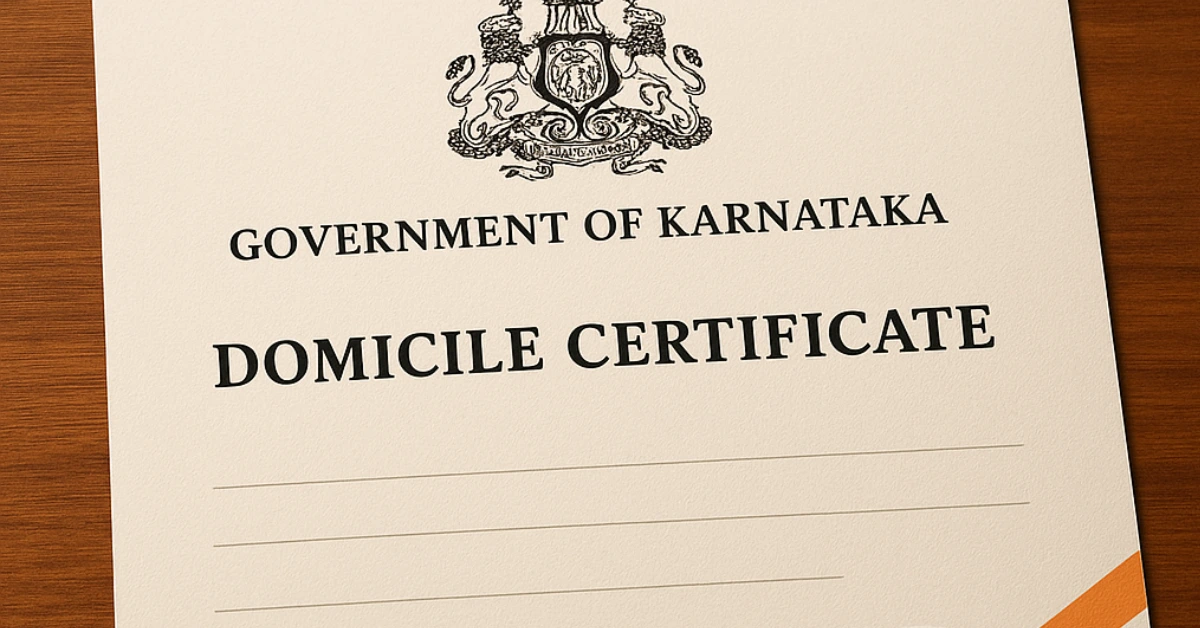
Secure your formal proof of residency through official state e-District channels or local revenue offices with this definitive administrative walkthrough.
A Domicile Certificate (or Residence Certificate) is an essential legal document issued by state governments in India to prove that an individual is a permanent resident of a specific state or union territory. This certificate is crucial for accessing state-sponsored scholarships, educational quotas, institutional admissions, government employment, and localized public utility benefits.
Add rightsofemployees.com as a Preferred Source




Applications can be completed smoothly either via state-specific digital citizen portals or through physical local administration hubs.
1. Eligibility Benchmarks
While specific regulatory guidelines are determined independently by individual state revenue departments, the general criteria required to establish eligibility include:
-
Continuous Long-Term Residency: The applicant or their parents must have permanently and continuously resided within the specific state for a government-mandated minimum duration (typically ranging between 3 to 15 years, depending on state policy).
-
Asset Ownership: The applicant holds registered ownership of residential land, a home, or immovable property within the state boundaries.
-
Matrimonial Baseline: A female applicant who is legally married to a permanent, recognized resident of that specific state.
Recent Posts
- Switching to an EV? Delhi’s New Policy Will Pay You Up to ₹1 Lakh to Scrap Your Old Car!
- Amazon Prime Day 2026: Best Running Shoes Under Rs 3,000 From Puma, Adidas & Nike
- Armed Forces Plan Higher Agniveer Retention Beyond 25% Cap as First Batch Nears Exit
- Growing Demand for E0/E10: Indian Motorists Signal Willingness to Pay Premium for Pure Petrol
- Row Over Ayodhya Ram Temple Funds Escalates as VHP and Congress Trade Charges
2. Standard Documentation Checklist
Applicants are required to assemble and self-attest scanned or physical copies of the following standard documents before launching their submission:
| Category of Proof | Acceptable Official Documents |
| Proof of Identity | Aadhaar Card, Voter ID (EPIC), PAN Card, or Valid Passport |
| Proof of Residence | Utility Bills (Electricity, Water), Bank Passbook (Updated), or Registered Rent Agreement |
| Proof of Age / Birth | Birth Certificate, School Leaving Certificate (SLC), or Official Academic Marksheet |
| Residency Evidence | Historical Property Tax Receipts, Legacy Ration Cards, or Continuous Educational Certificates |
Pro-Tip: Most regional authorities also require passport-sized photographs and a signed, notarized self-declaration affidavit affirming that the statements provided in the application are authentic.
3. Step-by-Step Application Workflow
Method A: Online Application Protocol
Digital processing is managed through state-specific e-District portals (such as Aaple Sarkar in Maharashtra, Seva Sindhu in Karnataka, or edistrict in Uttar Pradesh).
Online Application Funnel:
🏢 Visit State Portal ➔ 🔑 Register/OTP Login ➔ 📂 Select "Domicile Service" ➔ 📝 Fill Form ➔ 📄 Upload Documents ➔ 💳 Pay Processing Fee ➔ ⏱️ Track Tracking ID
-
Navigate to the Designated Portal: Open the official e-District or citizen service web address assigned to your state.
-
Account Creation & Authentication: Register as a new user by inputting your mobile number or linking an identifier, and authenticate the active session via a secure One-Time Password (OTP).
-
Locate the Departmental Service: Search for “Domicile Certificate” or “Permanent Residence Certificate (PRC)” housed under the Revenue Services or Citizen Services dashboard menu.
-
Data Ingestion: Complete the structured data form exactly as your information reads on your primary identification cards.
-
Digital Uploads: Attach all required documents in the specified format (typically restricted to clear PDF or JPEG formats).
-
Transactional Fee Settlement: Pay the necessary state processing fee. Costs vary across geographic locations, usually sitting between ₹30 and ₹100 (though select states provide this service entirely free of charge).
-
Submission and Status Tracking: Save the unique acknowledgment or transaction reference number generated on your receipt. The official verification pipeline typically processes and issues the final downloadable digital certificate within 7 to 15 business days.
Method B: Offline Application Protocol
For individuals preferring direct submission or requiring physical document authentication:
-
Visit the Administrative Office: Head directly to your local Tehsil office, Revenue Department, Sub-Divisional Magistrate (SDM) headquarters, or District Collector’s office. Alternatively, you can visit a designated neighborhood Common Service Center (CSC) or a Nadakacheri center if located in Karnataka.
-
Procure and Fill the Form: Obtain a physical copy of the Domicile/Residence Application form from the helpdesk and fill it out completely in block letters.
-
Counter Submission: Attach self-attested photocopies of all supportive documentation from the checklist, settle the processing fee at the cash counter, and ensure you collect your stamped acknowledgment receipt.
-
Collection: Track the file progress using your receipt tracking ID online, or return to the physical administrative hub to pick up your printed certificate once signed off by the reviewing officer.
Recent Posts
- Switching to an EV? Delhi’s New Policy Will Pay You Up to ₹1 Lakh to Scrap Your Old Car!
- Amazon Prime Day 2026: Best Running Shoes Under Rs 3,000 From Puma, Adidas & Nike
- Armed Forces Plan Higher Agniveer Retention Beyond 25% Cap as First Batch Nears Exit
- Growing Demand for E0/E10: Indian Motorists Signal Willingness to Pay Premium for Pure Petrol
- Row Over Ayodhya Ram Temple Funds Escalates as VHP and Congress Trade Charges
Add rightsofemployees.com as a Preferred Source