
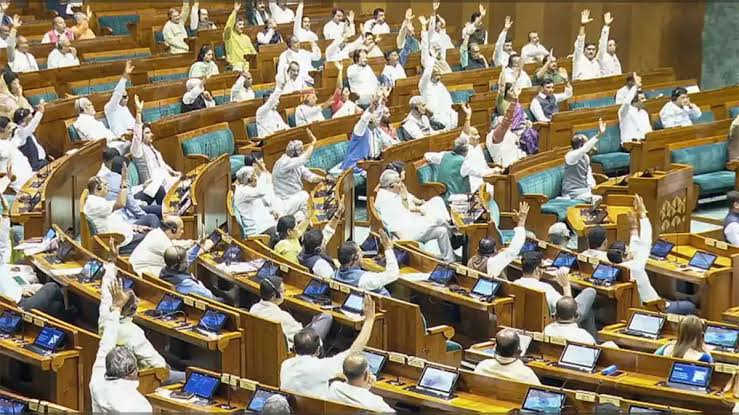
The amended legislation proposes tougher penalties, fast-track courts and time-bound investigations to curb examination fraud, and now awaits approval in the Rajya Sabha.
The Lok Sabha on Wednesday passed the Public Examinations (Prevention of Unfair Means) Amendment Bill, 2026, paving the way for stricter action against examination paper leaks. The legislation proposes imprisonment of up to 10 years and fines of up to ₹50 lakh for individuals found guilty of paper leak offences.
Add rightsofemployees.com as a Preferred Source




Related Article Suggestions
- Vi Launches Rs 200 Prepaid Plan With 20 OTT Apps, 30GB Data and Unlimited 5G
- India’s First Hydrogen Train Completes 1,200 km Trial Runs, Saves Over 3,200 Litres of Diesel
- CBDT Tightens Crypto Tax Reporting Rules, Signals Push for Greater Transparency
- Upcoming IPOs This Week: Manipal Health, Juniper Green, MV Electrosystems Lead Busy Primary Market
- Government Approves RBI Pilot for ₹10 and ₹20 Polymer Currency Notes
The Bill was passed by voice vote after an intense debate in the House and will now be taken up for consideration in the Rajya Sabha.
Tougher punishment for paper leak offences
Introduced by Union Minister Jitendra Singh on July 27, the Bill seeks to strengthen the existing anti-paper leak law enacted in 2024.
Key provisions include:
- Up to 10 years’ imprisonment for paper leak offences.
- Fines of up to ₹50 lakh for convicted individuals.
- Penalties of up to ₹10 crore for organised paper leak syndicates.
- Increased fines of up to ₹5 crore for service providers.
- Enhanced penalties for directors, management personnel and officials responsible for conducting public examinations.
The government said the amendments are aimed at creating a stronger legal framework to deter examination malpractice.
Fast-track courts and quicker investigations
The legislation also proposes structural reforms to speed up the investigation and trial of paper leak cases.
Under the amended law:
- Every state can establish dedicated fast-track courts for paper leak cases.
- Investigations must be completed within two months.
- Trials will be conducted on a priority basis to ensure faster disposal of cases.
The government believes these measures will improve accountability and strengthen the credibility of public examinations.
Heated debate in Lok Sabha
The discussion on the Bill witnessed sharp exchanges between the government and the Opposition over police action during recent student protests linked to the alleged NEET paper leak.
Leader of the Opposition Rahul Gandhi alleged that excessive force had been used against protesting students and questioned the government’s handling of the demonstrations.
His remarks triggered protests from members of the ruling alliance, who sought evidence to support the allegations. Lok Sabha Speaker Om Birla reminded members that allegations made in the House should be substantiated.
Responding to the criticism, Jitendra Singh rejected the allegations, stating that no bullets were fired during the protests and that tear gas was used for crowd control. He also clarified that any order to open fire could only be issued by a magistrate.
Related Article Suggestions
- Vi Launches Rs 200 Prepaid Plan With 20 OTT Apps, 30GB Data and Unlimited 5G
- India’s First Hydrogen Train Completes 1,200 km Trial Runs, Saves Over 3,200 Litres of Diesel
- CBDT Tightens Crypto Tax Reporting Rules, Signals Push for Greater Transparency
- Upcoming IPOs This Week: Manipal Health, Juniper Green, MV Electrosystems Lead Busy Primary Market
- Government Approves RBI Pilot for ₹10 and ₹20 Polymer Currency Notes
Government defends amendments
Defending the legislation, Jitendra Singh said the amendments were based on the government’s experience in implementing the Public Examinations (Prevention of Unfair Means) Act, 2024.
He said authorities had acted promptly in cases linked to the NEET paper leak and that 52 FIRs had been registered since the law came into effect.
The minister added that stronger penalties were intended to dismantle organised cheating networks and protect the integrity of India’s examination system.
Bill follows nationwide protests
The amendments come after weeks of nationwide protests over alleged examination irregularities and the NEET paper leak controversy.
The demonstrations, which lasted for over a month, called for greater transparency in public examinations, reforms to the National Testing Agency (NTA) and accountability for those responsible for repeated paper leak incidents.
The protests concluded after the government accepted several demands, including leadership changes in the Education Ministry, compensation measures for affected families and the withdrawal of cases filed against protesters.
Next step
Following its passage in the Lok Sabha, the Bill will now move to the Rajya Sabha for consideration.
After the legislation was approved by the Lower House, Union Education Minister Pralhad Joshi said the amended law would strengthen efforts to curb examination malpractice and help safeguard the credibility of public examinations across the country.
FAQ
What does the Anti-Paper Leak Bill propose?
The Bill introduces stricter penalties for examination paper leaks, including imprisonment of up to 10 years, higher fines, fast-track courts and time-bound investigations.
What is the maximum punishment under the Bill?
Individuals convicted of paper leak offences can face up to 10 years in prison and fines of up to ₹50 lakh, while organised syndicates may face fines of up to ₹10 crore.
Has the Bill become law?
Not yet. The Bill has been passed by the Lok Sabha and now awaits consideration and approval in the Rajya Sabha before completing the legislative process.
Why was the Bill introduced?
The amendments were brought after widespread concerns over examination paper leaks, particularly the NEET controversy, and aim to strengthen the legal framework for preventing unfair practices in public examinations.
Related Article Suggestions
- Vi Launches Rs 200 Prepaid Plan With 20 OTT Apps, 30GB Data and Unlimited 5G
- India’s First Hydrogen Train Completes 1,200 km Trial Runs, Saves Over 3,200 Litres of Diesel
- CBDT Tightens Crypto Tax Reporting Rules, Signals Push for Greater Transparency
- Upcoming IPOs This Week: Manipal Health, Juniper Green, MV Electrosystems Lead Busy Primary Market
- Government Approves RBI Pilot for ₹10 and ₹20 Polymer Currency Notes
Add rightsofemployees.com as a Preferred Source