

From mandatory investment reporting under presumptive schemes to expanded property fields and offline Excel utilities, here is what self-employed taxpayers need to know.
The Income-Tax Department has officially notified and enabled the digital frameworks for all Income Tax Return (ITR) forms for the Assessment Year 2026-27 (Financial Year 2025-26). To facilitate smoother pre-filing preparation, the e-filing portal has rolled out the dedicated offline Excel Utilities for ITR-1 (Sahaj), ITR-2, ITR-3, and ITR-4 (Sugam). Taxpayers can now download these schemas, structure their financial declarations offline, generate a verified JSON file data payload, and upload their submissions securely to the central system.
Add rightsofemployees.com as a Preferred Source


Among the updated forms, the ITR-4 (Sugam) has received specific structural adjustments that small business owners, digital freelancers, and independent professionals must closely evaluate before executing their compliance filings.
Recent Posts
- PM Kisan 23rd Installment Live: Direct Link and Step-by-Step Guide to Check Your ₹2,000 Status
- India’s Largest Public Issue: Jio Platforms Formally Files DRHP for Historic $4 Billion IPO
- Evolving Intimacy: Tier-2 Hubs Outpace Mega-Metros in Ashley Madison’s India 2026 Report
- Rohit Sharma’s amazing agility even at 39! He takes three consecutive catches in the slips.
- Turai Tikki Recipe: Children will not make faces after seeing ridge gourd! Make its crispy tikkis for evening snack, you will eat it on demand.
                           [ITR-4 Sugam Core Eligibility Matrix]
                                              │
         ┌────────────────────────────────────┴────────────────────────────────────┐
         ▼                                                                         ▼
   [Income Limits & Assets]                                              [Presumptive Tax Anchors]
 • Total Gross Income: Up to ₹50 Lakh.                                 • Section 44AD: Retail/General Business.
 • Capital Gains: Under Section 112A up to ₹1.25 Lakh.                 • Section 44ADA: Specified Professionals.
 • Agribusiness: Agricultural income capped up to ₹5,000.              • Section 44AE: Goods Carriage Transport.
 • Exclusions: Complete bar on LLPs and non-ordinary residents.         • Note: Requires mandatory investment logs.
Critical Adjustments Introduced in the New ITR-4 Form
To enhance data granularity and simplify documentation, the tax department has introduced four foundational changes to the Sugam layout:
-
Mandatory Investment Disclosures: Small business owners opting for presumptive taxation models must now explicitly report all financial investments held as of March 31, 2026, within their schedule logs.
-
Unrealised Rent Allocation Field: Landlords benefit from a dedicated, distinct field added to declare “rent which cannot be realised,” allowing clean deductions for uncollectible rental balances without cluttering alternative accounting lines.
-
Dual House Property Window: In alignment with ITR-1 revisions, the layout has been adjusted to allow taxpayers to seamlessly report income details derived from up to two distinct house properties instead of being limited to a single property entry.
-
Foreign Asset Reporting Relief: The specific compliance modules tracking foreign retirement benefit reporting requirements have been cleanly removed from the form’s core schedules.
[Presumptive Turnover Declared] ──► Requires Investment Disclosures Held up to March 31, 2026
                                                  │
                                                  ▼
[Cross-Verified via AIS & 26AS] ──► Ensures Smooth Electronic Clearing and Matches Bank Entries
Technical Eligibility Boundaries for ITR-4 Filers
The Sugam form remains the designated return path for resident individuals, Hindu Undivided Families (HUFs), and partnership firms (excluding Limited Liability Partnerships) whose primary income is computed using the presumptive tax framework. Eligible taxpayers can declare income under these specific legal modules:
-
Section 44AD: For standard businesses, declaring net profits at 8% of gross turnover (or a reduced 6% for digitally cleared transactions).
-
Section 44ADA: For specified professionals (medical, legal, engineering, tech consulting), declaring net profits at a baseline minimum of 50% of gross receipts.
-
Section 44AE: For transport operators engaged in the business of plying, hiring, or leasing goods carriages.
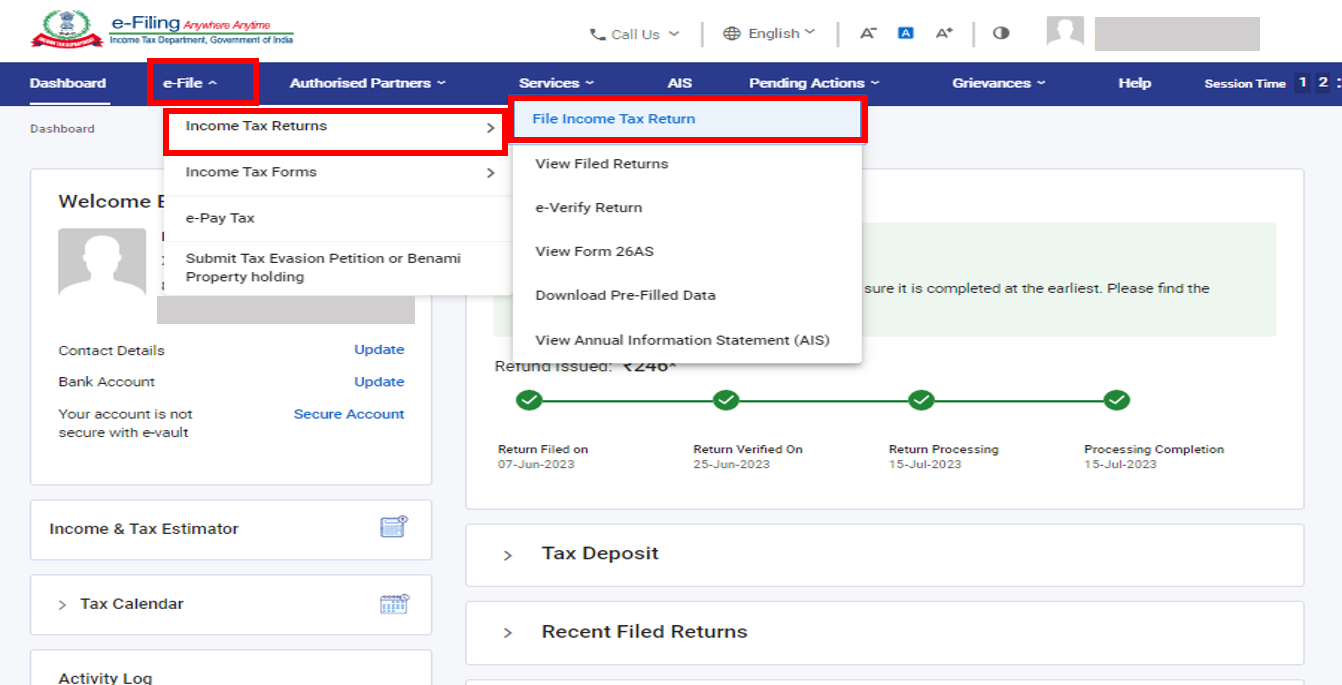
Step-by-Step Guide to Filing Your Electronic ITR-4 Return
To minimize validation errors during submission, file your return systematically by following this sequence:
SECTION 4 — FAQ
Q1: Can an individual with capital gains income file their taxes using the ITR-4 form?
Yes, but with strict limitations. Taxpayers can file via ITR-4 if they have long-term capital gains under Section 112A up to an amount of ₹1,25,000. If your capital gains exceed this limit or stem from other asset classes, you must use ITR-2 or ITR-3.
Q2: What is the benefit of the new Excel Utility option for AY 2026-27?
The Excel Utility allows taxpayers to fill out their extensive financial, turnover, and asset investment schedules offline at their convenience. This mitigates portal timeout errors, allows users to check entries thoroughly, and simplifies data compiling prior to generating and uploading the final JSON payload.
Q3: Is a taxpayer required to provide a physical identity card copy while verifying the online return?
No. The entire verification layer is handled digitally. Taxpayers can seamlessly e-verify their submitted forms online within minutes using a mobile network-delivered OTP linked to their official identity profile or via Net Banking and electronic verification codes (EVC).
Recent Posts
- PM Kisan 23rd Installment Live: Direct Link and Step-by-Step Guide to Check Your ₹2,000 Status
- India’s Largest Public Issue: Jio Platforms Formally Files DRHP for Historic $4 Billion IPO
- Evolving Intimacy: Tier-2 Hubs Outpace Mega-Metros in Ashley Madison’s India 2026 Report
- Rohit Sharma’s amazing agility even at 39! He takes three consecutive catches in the slips.
- Turai Tikki Recipe: Children will not make faces after seeing ridge gourd! Make its crispy tikkis for evening snack, you will eat it on demand.
Add rightsofemployees.com as a Preferred Source