

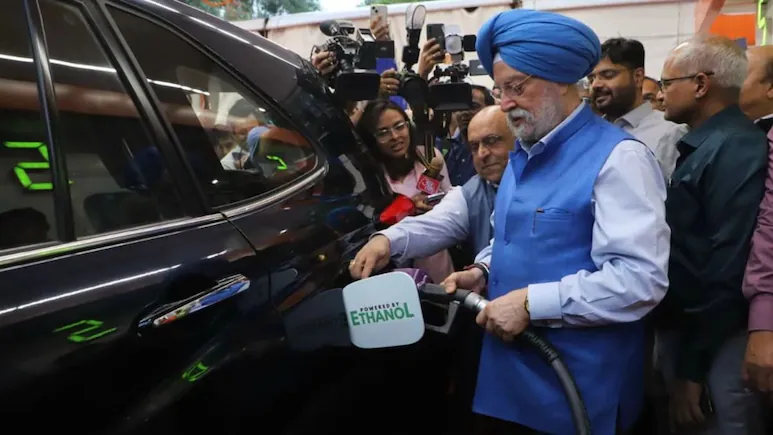
E85 Fuel Debuts in Delhi at ₹82.12/Litre: A Look at Compatibility and Real-World Costs
India’s aggressive push toward alternative energy achieved a major milestone with the official launch of E85 fuel at select dispensing stations in Delhi. Priced competitively at ₹82.12 per litre, the high-ethanol blend undercuts standard petrol by nearly ₹20 to ₹28 per litre depending on the city, presenting an attractive retail price point for motorists.
Add rightsofemployees.com as a Preferred Source


However, the introduction of this fuel introduces critical technical challenges regarding vehicle powertrain compatibility and the actual economics of vehicle running costs.
Technical Specifications: What is E85?
Unlike the nationwide E20 fuel blend (which contains up to 20% ethanol and 80% petrol), E85 is a high-concentration alternative consisting of up to 85% ethanol blended with just 15% standard petrol.
Because ethanol possesses vastly different chemical and physical properties compared to fossil fuels, it cannot be used interchangeably in standard internal combustion engines.
-
Corrosivity: High ethanol concentrations are highly corrosive to standard rubber seals, fuel lines, and aluminum components found in conventional fuel delivery systems.
-
Octane & Combustion: Ethanol alters the air-fuel ratio requirements, demanding specialized electronic control unit (ECU) mapping to manage ignition timing.
Vehicle Compatibility: Can Your Car Run It?
Critical Warning: The vast majority of petrol-powered cars currently operating on Indian roads cannot use E85 fuel.
Even if a vehicle is fully compliant with modern E20 fuel mandates, it is mechanically unequipped to process E85. Attempting to run a standard vehicle on this blend risks severe fuel system degradation, persistent engine misfires, and permanent mechanical failure.
To legally and safely utilize E85, a vehicle must be certified as a Flex-Fuel Vehicle (FFV). These specialized automobiles feature hardened fuel systems and smart sensors that automatically detect the ethanol-to-petrol ratio, adjusting engine calibration metrics seamlessly in real-time.
While manufacturers like Maruti Suzuki have actively showcased working prototypes—such as the Wagon R Flex Fuel—mass-market commercial availability of FFVs in India remains in its infancy.
The Efficiency Paradox: Does E85 Actually Save Money?
While a retail price of ₹82.12 per litre seems highly economical compared to Delhi’s standard petrol prices, the underlying physics of ethanol alters the financial breakdown.
Ethanol has a lower energy density than pure petrol. Data from established global flex-fuel markets like Brazil and the United States shows that vehicles operating on E85 suffer a 20% to 30% drop in fuel efficiency (kmpl) compared to standard petrol.
Real-World Cost Analysis
The table below demonstrates how a drop in thermal efficiency can offset a lower price at the pump, based on a standard driving profile:
| Metric | Standard Petrol | E85 Flex-Fuel | Resulting Change |
| Fuel Price (Delhi) | ~₹102.12 / L | ₹82.12 / L | ~20% Cheaper at Pump |
| Engine Efficiency | 15.00 kmpl | 11.25 kmpl | 25% Efficiency Loss |
| Calculated Running Cost | ₹6.81 per km | ₹7.30 per km | 7.2% More Expensive |
Because the car must burn more fuel to cover the same distance, the net cost per kilometer can actually rise, proving that a lower per-litre price does not automatically yield lower operational costs.
The Broader Objective: Macroeconomic Benefits
For the Government of India, the true utility of E85 goes beyond consumer-level savings. The rollout serves three distinct macroeconomic and environmental strategies:
-
Lowering the Import Bill: Displacing crude oil imports with domestically manufactured fuel preserves crucial foreign exchange reserves.
-
Supporting Agriculture: India’s ethanol supply is heavily derived from agricultural feedstocks like sugarcane surplus and damaged food grains, directly supporting the domestic rural economy.
-
Tailpipe Emission Mitigation: Ethanol burns cleaner than fossil fuels, significantly lowering lifecycle carbon monoxide and hydrocarbon emissions.
For the everyday consumer, E85 currently stands as a promising technology showcase. Until flex-fuel vehicles become widely available at commercial dealerships, standard petrol and E20 blends will remain the default choice for mainstream motorists.
Recent Posts
- India T20 Squad: Shreyas Iyer Named Captain; Sooryavanshi Called Up
- Oil India Strikes Gas Again with Second Andaman Offshore Find
- New US Bill Aims to End H-1B Green Card Pathway and OPT
- Delhi Metro Phase 5A: Work started on this new route of Delhi Metro, the fortunes of these areas will shine, 10 new stations will be built.
- Gold and Silver Price: Gold becomes cheaper by Rs 3000, silver also falls by Rs 14000, check latest rates
Add rightsofemployees.com as a Preferred Source